

Reflections on the dogs we have lived with…
Mimi looked up at me with hopeful eyes, as if to ask, “You helped me before. Why can’t you help me now?” She had never gone into the street until that day – a rainy day that made her greying black Poodle coat hard to see. The driver was apologetic. “I’m so sorry. I didn’t see your dog.” Her old eyes probably couldn’t tell the difference between the wet street and the yard anymore. I tried to make her comfortable. God knows it was a miracle she dragged herself back to the garage. As she lay there on the towel Mom brought out, I knew she wouldn’t make it. I had helped her before, but that was just ear drops, eye salve, or special shampoo, not a crushed pelvis and massive internal bleeding. This time I felt totally helpless. There was nothing anyone could do except keep her calm. She breathed her last breath within a few merciful minutes.
She was a good dog; a companion to the three of us and the apple of Mom’s eye. She became Dad’s golf ball retriever and learned to run halfway to the target zone by the time Dad hit the ball. Then she would drop it within inches of where he needed it to be for the next wedge shot. Mimi could catch a golf ball on the first or second bounce – until she could no longer see well enough and a ball accidentally dropped on her head. From then on, she would only watch or wait on the sidelines. She had a good life, but all good things do come to an end. By the time I left for college, Mimi had become a memory. It would be over 20 years until my next dog.
Berlioz began his life with us in 1992. Our daughter was almost nine and we had promised her a dog. And what a dog he turned out to be! For almost 12 years he was a wonderful companion to her and our son. One day, trying to follow my daughter, he boarded the school bus and I had to run out in my pajamas to bring him back to the house. Her classmates all had a good laugh at my expense. When the kids went off to college, Ber became our boy. We walked in rain, snow, and freezing cold. It seems to me one of the things we learned from Ber was the value of acceptance. Dogs don’t think in terms of how something could be better or wasn’t as good as last time. Judging from his reactions, each show of affection, each ride in the car, each walk, each meal was the best, ever. He, like all dogs, lived in the moment, a trait I wish more people would adopt. We live lives of comparison with others, unrealistic expectations, and all the unfair judgments that come with being a human. For dogs, happiness is being with us. Period.
When one of us was sick, Ber was there for comfort. When we returned home, Ber was there to greet us. When we took him to work, he relished the attention of our students and colleagues. He may not have come when called, but when it was time for a walk or ride, we didn’t have to ask twice. I wished our young kids had followed that example more often. I once spent a few nights in the back of our van with Ber. My mother-in-law didn’t want a dog in her house. It was of course her house and her right to let Ber in or not, but I was not going to go along with her. I’ve always thought a dog should be part of your family and if you are just going to lock him up or chain him outside, it would be better if you didn’t get a dog in the first place. Ber turned out to be a good bedfellow. We slept well in the van, as I recall it.
Ber also developed a sense of trust for us. Dogs look to their humans for comfort and security. If you think they don’t, you shouldn’t get a dog. They are social animals. We become part of their pack and if we do it right, we become their trusted leaders. They look to us for food, shelter, healthcare, and companionship. In most cases, they don’t choose to be our “pets.” We choose them. It seems to me if we want the right to choose them, we must take on the responsibility of taking good care of them. And, no matter what anyone thinks, they will become like us. When I meet a gentle dog, it seems to me the dog’s people are usually gentle as well. When I encounter a mean dog, it seems to me he has been treated badly, or poorly socialized, by mean or self-centered people. Maybe I’m making too much of “Call of the Wild,” but I’ve seen dog breeds with bad reputations become friendly and good-natured under the care of people who treat them with love and kindness. If you want your dog to become aggressive and untrustworthy, the easiest way to do this is to treat him with cruelty and neglect. Dogs are not that different from children in this respect. They understand instinctively that trust and loyalty must be earned, and if you manage to earn their trust, generally they will be loyal. It always amazes me when a badly-treated dog still forgives, still tries to be loyal, still aims to please.
Ber was as rambunctious as any puppy – tearing old towels into strips, chewing on shoes and furniture, tackling my four-year-old son, and even trying to play tug-o-war with my tie while I was wearing it. But after a year or so, he learned when to play and when to be nice. He became trustworthy around little children, letting them surround him and even pull on his hair. Never once did he snap or growl.
There was only one time when Ber barked viciously at a human – a man who hit a horse. He pulled on his leash harder than any other time I held it. I thought he might rip my arm off and charge across the street to defend that horse from its owner. It took a few minutes, and the horse and carriage moving on, to calm Ber down. If you don’t want a defender, don’t get a Great Pyrenees. Otherwise, Ber was as good as gold in public. Only an overly-aggressive dog might occasionally arouse his instinct to protect.
I taught Ber to run alongside a bicycle. He was the first of our four dogs I taught to do so. We were so proud of him trotting along with his tail in the air and head held high. What could be better than running alongside your human on a sunny day?
When the time came to say goodbye to Berlioz in 2004, we were heartbroken. Dogs, like people, can’t live on this planet forever. Ber had a rare condition that hardened his windpipe, restricted his air intake and caused him to pass out on several occasions. Not long before he went to sleep for the last time, I had to carry him inside to recover by the fire, or he would have died in the snow. Although the decision was rational and ended Ber’s suffering, it was still hard. Even when a family member or a friend dies of the frailties of age, it’s still hard to say goodbye. Some might think going through the process might make it easier, but it doesn’t. It seems to me each dog’s passing has been harder than the one before.
We got Pogo by chance in 1999. He was the dog that literally followed the kids home when they returned from walking a neighbor’s dogs. My daughter said, “God sent him to us.” He was a little Terrier mix, with a pointy nose, skinny legs, and floppy ears – funny-looking, but with a sweet heart and energy to spare. We called him Pogo because he enthusiastically jumped straight up in the air when he realized he was staying with us. He became a playmate for Berlioz, which the older dog liked. They played tug-o-war with ropes and towels. Pogo sometimes tried to pull out Ber’s tail hair, while Ber had fun putting his mouth around Pogo’s entire head. On walks together, they were the odd couple. Big and small, long hair and short, white and tan.
Later in life, Pogo became accustomed to sleeping on his pillow, between us. He felt comforted that way. Every night I would scoop him up from my side of the bed and gently place him on his pillow. At first, he would growl a little when I disturbed him, but after a few nights, he was at ease with it. Compared to Ber, he was a funny little fellow, but we loved him and pampered him the same as the big guy.
In 2013, we had to make the hard decision when Pogo became racked with pain and was in renal failure. We could no longer pick him up without having him cry out in pain, and the once intrepid Terrier who took on the Pyrenees for fun could hardly walk. The vet advised us to end his suffering, as he had with Ber a few years before. Again, it was hard – certainly not any easier than saying goodbye to Ber.
For a while we had three dogs. I called it a “three dog night” when we went out on a night walk. One of my daughter’s friends had accepted a puppy from a box of puppies of mixed origin. Sasha was part Rottweiler and part Golden Retriever – the ruddy color of the former with the soft fur of the latter, with touches of gold underneath and in her haunches. Sasha was probably the smartest dog we ever had. She could follow commands while running full-tilt beside my bike – go left, go right, go straight. I called her my “firehouse dog.” She was the only dog I’ve ever known who would just get in the tub when my wife said, “bath time.” Sasha also went to our bedroom when it was time for bed without being asked.
We got Sasha in 2004 when my daughter’s friend admitted he and his roommates had no time to raise a puppy. Again, my daughter thought it was her job – which meant our job, because she soon went off to college – to raise this cute little puppy. We suspected the guys yelled at her and possibly hit her because she was afraid of men at first. I made friends with her by lying on my belly and waiting for her to approach. Soon she began to trust me enough to hide behind my legs when a stranger came by. She became a loving companion, especially for my wife. She had a habit of saying, “woooo” when it was time for a meal. Sasha also let us know when it was time for a walk. Dogs revel in routine and it made us happy to provide her with a routine that made her happy.
Another thing about Sasha. She was an excellent judge of character. If she accepted a person, we could feel assured that they were good, and their heart was in the right place. But it might take patience. My mother tried to move too quickly, and Sasha never completely warmed up to her. One day, we were on campus walking Sasha off leash and she barked at our Dean, sending him scurrying back inside the building. He was the only person she ever warned off that way. Apparently, she agreed with a former colleague who told me to “watch your back” around the man. Maybe she knew something we didn’t, or something we only suspected.
Sasha battled with cancer for many months. When we said goodbye, my wife was devastated. This was the only passing I missed. I was out-of-town, and Sasha’s condition suddenly became much worse when her internal organs began to shut down. She was such a good girl. I cried while driving. So much for each dog’s passing getting easier.
When Belle came to us in 2012, Pogo saw her in the back yard and fearlessly rushed out to greet her. To this day, we believe he thought Belle was Berlioz, his old friend. Both were Great Pyrenees – large, white, and fluffy. But Pogo gave her a sniff and suddenly realized she was not Ber. He walked away out of caution, or possibly disappointment. Belle did not act threatening, but the little dog took his time. Eventually, he became friends with her, but perhaps not as close as with Ber. In many ways, the little dog taught the bigger dogs the rules of the house, which meant all the ways to endear themselves with the humans. Ber was famous for the “Pyr Paw,” a firm paw-tap on whatever body part is closest, to seek attention. Pogo learned the technique and taught it to Sasha. Belle already had a head start.
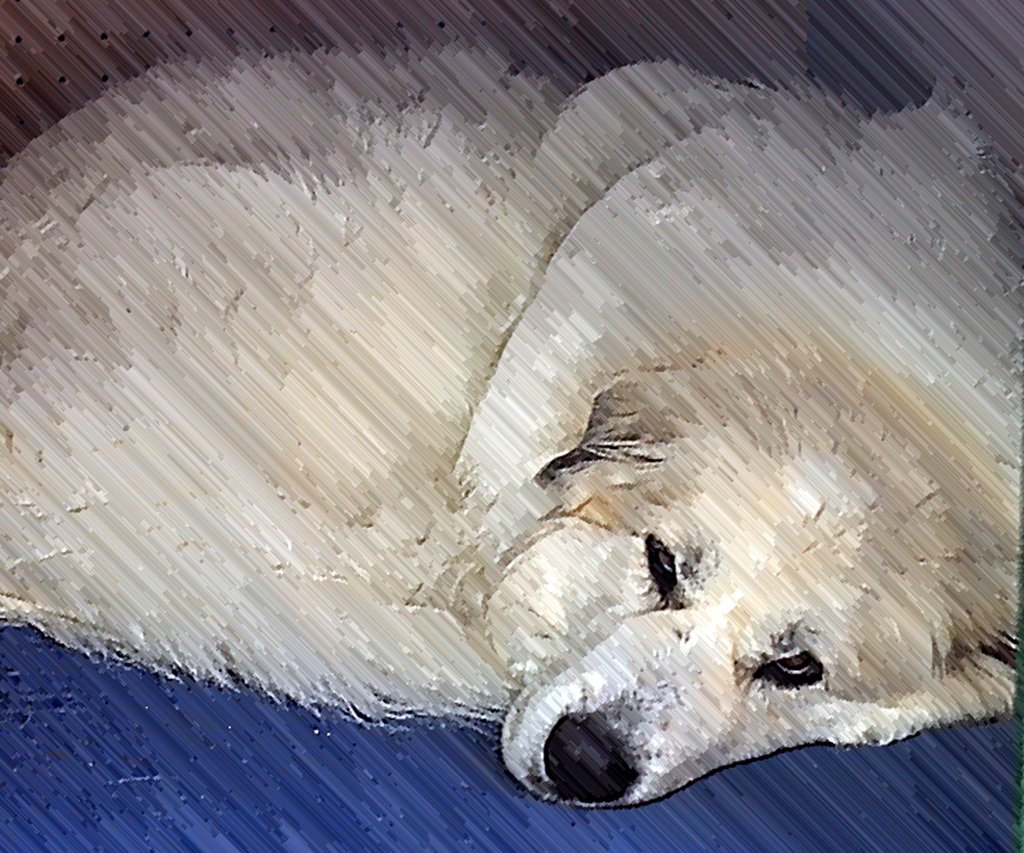
We dog-napped Belle. My daughter was going through a divorce and her soon-to-be ex had threatened to shoot Belle. So, we drove 1-1/2 hours to pick her up. Belle had already met me on several occasions, and it seemed she liked me. More than any other dog I’ve known, I felt she had chosen me. My daughter didn’t need to ask her twice to jump into our SUV and go for a ride to her new home. So, began a beautiful 10-year relationship, which ended when we said goodbye a few days ago. Belle liked to click her teeth when hungry, tap at the back door to be let in, and when she was younger, ramp all around when it was time for a walk. She loved guarding our backyard, the other dogs, and us as well. In her last year with us, she developed neurological problems which made it difficult for her to walk and get up or down and she was becoming increasingly disoriented. Near the end, being with us was probably her only pleasure. Even roast chicken had lost its appeal. At almost 13, she was feeling her age and growing weaker by the day. We rubbed her neck and ears to reassure her and said “we love you” one last time as she fell asleep.
In some ways, Belle’s passing has been harder for me than the others, as hard as they each were. A dog becomes part of your life in a thousand ways – all the little things you do as you look after them, and all the little things they do that endear them to you. We look out to where Belle once liked to take naps or survey her domain – and remember. We walk by where her dishes used to be, or where her bed was – and remember. We get in the car and drive to the park – now without her. We sit down to watch TV and there is no big, friendly baby napping near our feet. There is no longer any sweet, fluffy girl to greet us when we come home. As I write this, Belle’s paw prints remain in the snow, but not for much longer. The shelter I built for her will be given to another dog before long as well. Yet, we are thankful we still have dozens of photos and hundreds of memories.
Maybe saying goodbye gets harder because each dog’s passing reminds us a little more of our own mortality. As we get older, we realize that thirty years of our lives have passed while we were living with dogs. We come to understand that we can’t really own our dogs any more than we can own our children. Like children, they are merely entrusted to us for a season, on a relatively short-term lease. We’re granted only a few years to prove ourselves worthy of their love. During that time, they learn to count on us as we learn to count on them. I can only wish people could be as forgiving and loyal as our dogs. They were true friends in their own way. They gave as much as they received.
We know we can’t get the time with our dogs back, even though we would gladly do it all again. We loved them, and it seems they loved us. We hope they understood on some level that when it was time to say goodbye, we didn’t want to do it. We resisted the idea. We wanted them to live forever. Yet, we knew they couldn’t. Not in the condition they were in. To keep a suffering creature around is beyond cruel. As much as we didn’t want to say goodbye, it was the right thing to do. But sometimes the right thing to do doesn’t feel good. It hurts to the core of our being. This is the first time in 30 years we have lived without dogs. We miss their joy in ordinary things, their antics, their cuddles, and the reassurance of their presence. The little ways our dogs were entwined with our lives will be on our minds for a long time. We pray that in some way, some day we will meet them all again.
February 2022
 MurrayWorks