

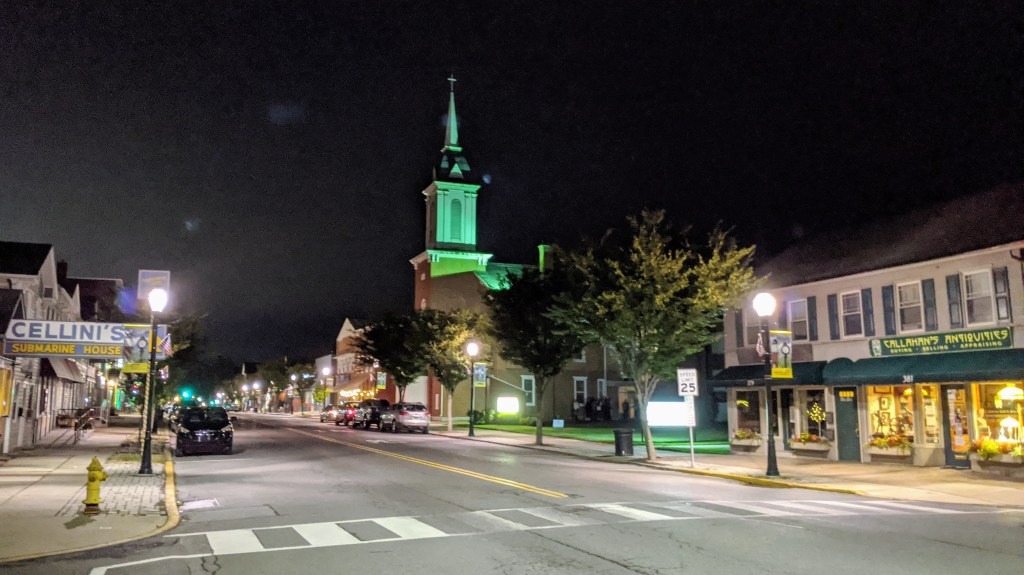
I grew up in small-town America – in the Borough of Montoursville, Pennsylvania, to be exact. Some may know the town for one of two reasons. In 1996, 16 Montoursville High School students in the French Club and their 5 chaperones perished on TWA Flight 800. My mother was president of the school board at the time, so I’ve heard a lot about it. And in 2020, President Donald Trump held two rallies at the Williamsport Regional Airport located in Montoursville.
Montoursville has one “main” street, known as Broad Street. There are six stoplights in the entire town, and two of those are out by Lowe’s and Walmart. Many of the streets are named after trees – Walnut, Chestnut, Spruce, Cherry, and my home street, Mulberry.
My house was wedged in between the local Catholic Church, “Our Lady of Lourdes,” and the Montoursville Presbyterian Church. The State Police Barracks was about a block away on the diagonal. It’s hard to get into trouble when you’re surrounded by goodness.
I had to walk at most a whole three blocks to get to school – either one, Elementary or High School – one was north of my house, the other was west. The Middle School was built after I graduated from High School. I went to class with some of the same teachers who had taught my parents. One even called me, Les, a few times. Most compared my work to “back when your dad was in my class.” In general, our teachers knew practically everyone, and our principals had principles. They backed up their teachers and tried to make sure students didn’t stray too far from their guidance. The head football coach also taught PE and often said he would not tolerate “lying, cheating, or stealing” on his team or in his class. If any of that happened, he said, “I’ll flunk you on the spot.” Very few wanted to run the risk of getting flunked. Even fewer wanted to cross coach Czap.
When I lived there, the good people of Montoursville tended to know everybody’s business. Many knew who I was and what I was up to. My paternal grandmother lived in town and so did my aunt (dad’s sister) and uncle, and two cousins. My uncle’s brother lived next door to him and was the postmaster for many years. The police force was small. I think there were only three or four officers, but they kept tabs on students who cut class to go to the pool hall or were out too late at night. Montoursville was not known for violent crime, or really much crime of any serious nature. To find crime, one had to go to Williamsport, a few miles away.
Nearly 6000 people lived in Montoursville in the early 70s. Now, about 4500 people live there. In recent years, the area has benefitted from the fracking boom and the installation of Interstate 180. I haven’t lived there since 1979, when I completed a master’s degree and began my career in Kentucky. Between 1973 and 1979 my residency was limited.
Montoursville was a wonderful place to grow up. I had lived in Ann Arbor, Michigan, in kindergarten and first grade, and Loyalsock Township, nestled between Montoursville and Williamsport, in second, third, and fourth grades. I’m glad we moved to Montoursville. It was my parents’ home town and my dad decided to build a house there after returning to the area a couple of years before. My maternal grandparents also lived in Montoursville, but by the time I was in high school, they bought a house in Loyalsock Township, 10 minutes away by car. There is something reassuring about your parents and grandparents living in the town where you grow up. I wouldn’t trade away the experience of living in Montoursville for anything. I am unbelievably grateful.
I realize many children simply do not have the privilege of growing up in places like Montoursville. Today Montoursville is 97% white, for instance. I wish it were true that every child could have the opportunity to grow up with the privileges I had. But “if wishes were horses, beggars would ride,” the saying goes. Many children have not experienced and will never experience what I did between 1955 and 1979.
The place I call my hometown still has quaint houses, gardens, window boxes, alleys where we used to ride our bikes, picket fences, churches of all major Christian denominations, a centrally located high school and elementary school, safe streets, a US Post Office, and a handful of good local restaurants. One can ride a bicycle anywhere they need to go. Many kids can still walk to school, and there are still buses for those who live farther out in the country. Loyalsock Creek runs between Montoursville and Williamsport, and Route 87 up “The ‘Sock” is a beautiful drive in the spring and fall. The ‘Sock runs into the West Branch of the Susquehanna River near the airport. It is a nice valley to call home.
Recently my wife and I visited my dad in Montoursville. Mom passed away in 2018. When we visit, we like taking walks around town and she likes hearing me talk about what the town was like 40 years ago compared to now. I remarked that I can understand how people in small-town America feel. There we were, walking down Broad Street late at night and not worrying about being assaulted. Many people in small towns grow up feeling relatively safe. When most people think about making America great, they think of the places where kids like me grew up. In the past, most people didn’t feel the need to lock their doors – while you were out, a neighbor might stop in for a glass of water or to use the phone in an emergency. And people had each other’s backs, even if they knew a little too much about each other’s business. Not that small-town America was Eden, but it was, and is, great in many ways.
While I was in Montoursville, I could sense the resistance of many of my fellow Americans to losing the safety and community of small-town life. My dad needs to drive less than a mile to get to the drug store, the hardware store, or Weiss Markets, the regional grocery store. He knows people at his bank and all the restaurants in town. His pharmacist knows him well enough to let my brother and I pick up his medications for him.
Why would anyone want to change a place like Montoursville, other than to promote more local jobs? One of the reasons for population decline in Montoursville is that so many industries have moved out of the area. Even so, I can understand the appeal of the “Law and Order” message. When one walks down Broad Street at night, the prospect of riots, looting, and arson, as remote as it may be, still sounds horrifying. Nobody wants their quiet little town to become like Portland, Minneapolis, Los Angeles, or New York City. So, fear of “the other” can be a powerful motivation.
Also, most residents of small towns are justifiably conservative. It seems to me they want things to stay as they are as much as possible. I can’t remember how many times I heard the phrase, “If it ain’t broke, don’t fix it” while growing up. Yet, not everyone has the opportunity to grow up in a safe, connected place. Not everyone has a nice little “hometown” to call their own. And things change. Montoursville is not the same as it was 40 years ago. Many homes have been refurbished. Streets have been repaved. Accessibility ramps have been installed. New sidewalks have been poured. There is a sewer system where septic tanks used to be. There is a rebuilt high school and there are new businesses on Broad Street. There is a Lowes and a Walmart. People now earn their livings in ways that were not thought of in the 1970s.
Obviously, life in places like Montoursville is not like “life in the big city.” To me, big cities will probably always be “nice places to visit, but I wouldn’t want to live there.” Yet, it seems to me we need small-town America and big-city America. There are many things that can be accomplished only in big cities. There are many experiences that can take place only in small towns. Further, the greatness of America doesn’t reside in its cities or towns, or in its military might, or even in its leaders. Greatness, if it exists at all, must reside in its people. The question in my mind is, “how can we make experiences like those I had more available to every child?” I have no answer to this question, but it seems to me listening to people from every part of the country would be a good place to start. If we continue to pit rural against urban, white against black, rich against poor, or “us” against “them,” we will get nowhere.
 MurrayWorks