

Darrell was always cocksure. Even as a boy, whenever anyone told him about something, he replied, “I know.” Later, he would say things like, “I know more about ___ than anybody,” or “Nobody knows more about ___ than I do.” Darrell’s beliefs were indistinguishable from facts, at least in his mind. If one of his acquaintances managed to get him to come along to a lecture or tour, he would confront the presenter with his opinions, which annoyed the other participants, but somehow made him feel superior, in the know, or at least better than people who spent their lives studying things he had clearly mastered by the age of 13. Darrell was 35. He was certain that chattel slaves were treated well, the number of lynchings was greatly exaggerated, school shootings and terrorist attacks were staged, and the holocaust never happened. He believed a secret cabal of Jews was running everything. Darrell had never left his county, much less his home state.
No one knows how his wife convinced him to go on a trip to Europe. Maybe the fact that she won the lottery had something to do with it. Yet, Darrell found himself in Budapest, on a walking tour about World War II and its impact on the city. He said he already knew “all about” WWII, but he tagged along to keep his wife happy.
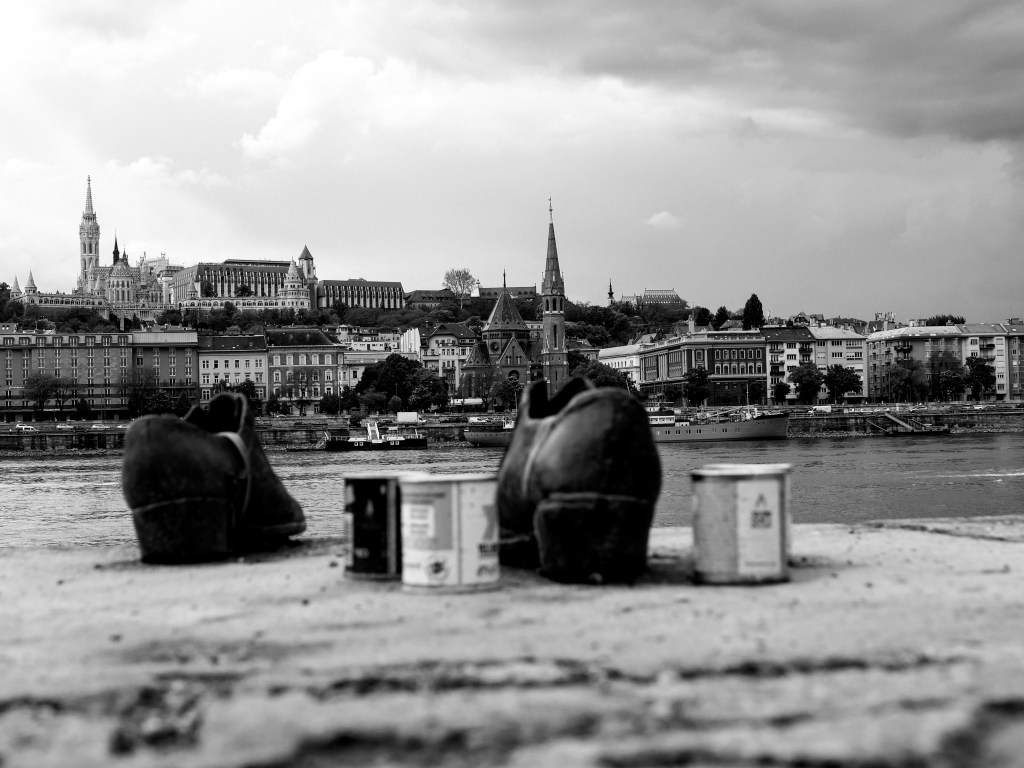
As they walked to the “Shoes on the Danube Bank” memorial, he muttered that the Jews just did this for sympathy. He was sure stories like this were just urban legends. The fact that people were singing, praying, and placing candles and flowers next to the shoes did nothing to dissuade him. “It was all a hoax. There’s no way that many people were just shot and pushed into the river. Anyhow, those that were deserved it. They were probably spies.”
“Shh…” Darrell’s wife tried to keep people around her from hearing his thoughts on the matter. She reflected that just across the Danube stood monuments to the Christian faith that were likely some of the last things these people saw before their deaths. She prayed Darrell would at least remain respectfully silent.
Just as Darrell’s commentary was rising to the level of disrupting the tour, a shadow rose from the murky water.
“Do you see that?” Darrell asked no one in particular.
“See what?” His wife answered.
“The shadow with the bright fuzzy light around it?”
“I don’t see anything.”
Darrell raised his voice, “Does ANYBODY see that…”
For Darrell, all fell silent. There was no memorial, no Danube, no tour. Even the pavement became indistinguishable from the now uniformly ashen sky. Out of the haze, a figure approached. Wearing a simple blue peasant dress and cloak, a young girl of 14 or 15 touched Darrell’s elbow. He could not speak. He could not move. He wanted to blurt out, “Who the hell are you?” But his train of thought ended with “Who…”
The girl spoke. “I am Anna, guardian of this holy place. I exist out of time and space. The souls of those who were murdered here have cried out for my grace. You, Darrell, will now listen to what I have to say.”
Darrell wanted to say, “This is bullshit,” but all he could manage was a nod of agreement.
Anna continued, “We shall travel back to that time. You shall witness the atrocities with your own eyes. You shall feel the paralyzing fear, the utter helplessness, the searing pain of erasure of those who died here. You shall see the smug certainty and hatred on the faces of those who pulled the triggers. You shall experience the last prayers of real human beings and the flow of their lives into this beautiful river. All times are one with me. That is my power. You will stand where and when I decide you must stand.”
Darrell summoned all his belligerence and at last spoke, “How do I know…this is not a trick?”
“It is not a trick,” Anna stated firmly. “The reality of what you deny will become apparent. Stand here.”
The world became solid again. The tour group and the bronze shoes were gone. In their place, there were stains on the hard ground. It was winter. Darrell had heard enough to guess it was late 1944 or early 1945, the time when the tour guide claimed 800 Jews were murdered along the riverbank. As he watched, a group of Arrow Cross Party police herded prisoners towards him at gunpoint as he stood in a puddle by the Danube. Was that blood around his shoes? Darrell wanted to run, but all he could do was stand like a statue and watch what happened to these people.
The prisoners were commanded to remove their shoes, their only remaining possessions that had value to the Nazi-inspired group. It dawned on Darrell that Nazis will only keep you around if they have some use for you. It wasn’t enough that freedom and property were stolen from these innocent people. Now, dignity and life were to be stolen as well. Darrell shivered along with the prisoners. He felt the bitter cold in every molecule of his body.
The guards told the prisoners to line up along the riverbank. Darrell realized he was standing shoulder-to-shoulder with them. He learned what it was like to have a rifle pointed at your head. He could hardly hear his own thoughts over the sobs of the women and children around him. Mothers tried to shield their children. Sons tried to shield their mothers. Old men tried to shield their grandchildren. In the end, none of that mattered. The brutes who lined them up to be slaughtered would just shoot though one to kill both with the same bullet. If any were still alive, they kicked them into the river to drown downstream.
Darrell wanted to shout, “STOP!” at the top of his lungs, but his breath was sucked out of his body as the bullets slammed into the prisoners. Blood splattered onto his clothes. Was that a piece of grey matter on his shoulder? He wanted to vomit. Yet, he could do nothing. He was as helpless as those around him. All he could see was the faces of the fallen, pleading for help, hoping for clemency from the smirking party minions. As the bodies drifted in the eddies of the Danube, it occurred to Darrell that the next time someone talked about man’s inhumanity to man, he should take that seriously. He realized that there were many things that up until now he just didn’t want to know. His know-it-all attitude was after all only a way to protect himself from those things.
Darrell was thoroughly frozen in body, mind, and spirit. Where was Anna? She just left him by the river, alone with his thoughts. None of the participants in the tragedy that unfolded around him could see or hear him. The bullets had no effect on him even as they ripped through the bodies of everyone else. He was utterly cut off from the world as he knew it. He was so certain of everything up to now – whenever now was. Maybe Anna wanted him to find out how it felt to be truly alone. He had no idea how much time had passed since the militiamen had done their gruesome duty and gone home. He remained still, treelike, afraid to take a step in any direction.
At last, Darrell could speak. “Anna?” He called out tentatively.
He tried again. “Anna?” He was beginning to feel even God had forgotten about him.
Maybe one more time. “Anna?”
“It’s time to go home, Darrell,” she said plainly.
Darrell was once again with his wife on the tour of Budapest. He looked at his shirt. No grey matter. His pants. No blood. No sign of the horror he had just witnessed. He looked at his new shoes. They were covered with blood. There was only one way that could have happened. Was this what Anna meant when she said the truth would become apparent?
Darrell’s wife noticed his usual chatter was conspicuously absent. “What happened to your shoes?” she asked.
All Darrell could think to say was, “I’m sorry.”
 MurrayWorks